

Update: This article was originally published in April 2024 and analyzes Tether’s terms and reserve composition as they existed at that time. Tether’s terms have subsequently changed. As of February 26, 2026, Tether’s terms provide for redemption of USD₮ in U.S. dollars, subject to applicable requirements and fees. The analysis below should therefore be read in the context of the terms in effect when the article was published.
On March 18, 2024, Mega Matrix Corp. filed a Form 10-K in which it reconsidered the classification of its USDT holdings. The company noted that Tether’s user agreement permitted redemption using assets held in Tether’s reserves, including potentially non-financial assets. On that basis, Mega Matrix concluded that USDT did not appear to meet the definition of a financial instrument under ASC 825-10-20 and reclassified approximately $90,100 of USDT from stablecoins to digital assets. The reclassification did not affect the company’s net assets, revenue, or net loss.

Today, we will try to take another look at accounting for USDT and learn more about what challenges the current definition of a financial instrument creates.
USDT is commonly accounted for as a financial asset in a manner similar to USDC. This accounting has been rooted in the treatment of USDC described in Coinbase’s financial statements. Coinbase has accounted for USDC as a financial instrument and noted that USDC is redeemable one-for-one for U.S. dollars.
In order to answer whether it is appropriate to account for USDT under the same model as USDC, we need to understand what a financial instrument is. The FASB Master Glossary defines a financial instrument to include cash, an ownership interest in an entity, or a contract that creates specified contractual rights and obligations involving cash or other financial instruments.
The definition can operate through a chain of contractual rights and obligations, provided that the chain ultimately results in the delivery of cash or an ownership interest in an entity. Those contractual rights and obligations may also depend on the occurrence of a specified event. [FASB ASC Master Glossary, Financial Instrument]
As noted above, a chain of contractual obligations that ultimately ends with the delivery of cash or an ownership interest in an entity may qualify as a financial instrument. Another significant point is that an obligation within that chain may be conditioned on the occurrence of a specified event. Accordingly, a contractual right or obligation does not necessarily fall outside the definition merely because cash settlement is conditioned on a specified event.
It may be interpreted in different ways, but the presence of a single realistic scenario in which an obligation is settled in cash is generally sufficient to classify such an obligation as a financial instrument.
Let’s provide a specific example, and it's a relatively simple one. Under U.S. GAAP, the accounting for advance payments denominated in a foreign currency depends in part on whether the advance payment is refundable.
Deloitte’s guidance explains that refundable deposits and advances denominated in a foreign currency are monetary assets or liabilities and are remeasured using the current exchange rate at each reporting date. [See Deloitte’s Roadmap: Foreign Currency Matters, Section 4.7]
Based on this guidance, refundable advance payments are treated as monetary assets and are remeasured based on changes in the foreign-currency exchange rate. Nonrefundable advance payments that are nonmonetary are generally measured using the applicable historical exchange rate. This gives us one example of a situation in which the possibility of cash settlement affects the accounting for an asset.
One additional point is that monetary assets and financial assets are not synonymous. For example, an investment in common stock can be a financial asset without being a monetary asset. [See EY, Nonmonetary Transactions]
I summarized the main idea in the following chart:
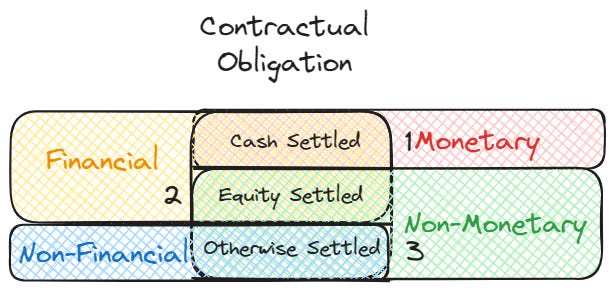
Based on this analogy, we can infer that the ability to settle the obligation in cash may be sufficient to account for it as a financial instrument. Can we apply this criterion to USDT? Let’s review the documents containing Tether’s terms.
About Tether Tokens; General Restrictions; Forks: Tether issues and redeems Tether Tokens. Tether Tokens may be used, kept, or exchanged online wherever parties are willing to accept Tether Tokens. Tether Tokens are 100% backed by by Tether’s Reserves. Tether Tokens are denominated in a range of Fiat. For example, if you purchase EURT, your Tether Tokens are 1-to-1 pegged to Euros. If you cause to be issued EURT 100.00, Tether holds Reserves valued at €100.00 to back those Tether Tokens. The composition of the Reserves used to back Tether Tokens is within the sole control and at the sole and absolute discretion of Tether. Tether Tokens are backed by Tether’s Reserves, including Fiat, but Tether Tokens are not Fiat themselves. Tether will not issue Tether Tokens for consideration consisting of the Digital Tokens (for example, bitcoin); only money will be accepted upon issuance. In order to cause Tether Tokens to be issued or redeemed directly by Tether, you must be a verified customer of Tether. No exceptions will be made to this provision. The right to have Tether Tokens redeemed or issued is a contractual right personal to you. Tether reserves the right to delay the redemption or withdrawal of Tether Tokens if such delay is necessitated by the illiquidity or unavailability or loss of any Reserves held by Tether to back the Tether Tokens, and Tether reserves the right to redeem Tether Tokens by in-kind redemptions of securities and other assets held in the Reserves. Tether makes no representations or warranties about whether Tether Tokens that may be traded on the Site may be traded on the Site at any point in the future, if at all.
[Excerpt from Terms of Service (Last updated: December 7, 2023) of Tether]
As of today, USDT reserves have been allocated to the following non-financial asset categories:
precious metals - 3.62%
bitcoin - 2.91%
other investments - 3.89%1
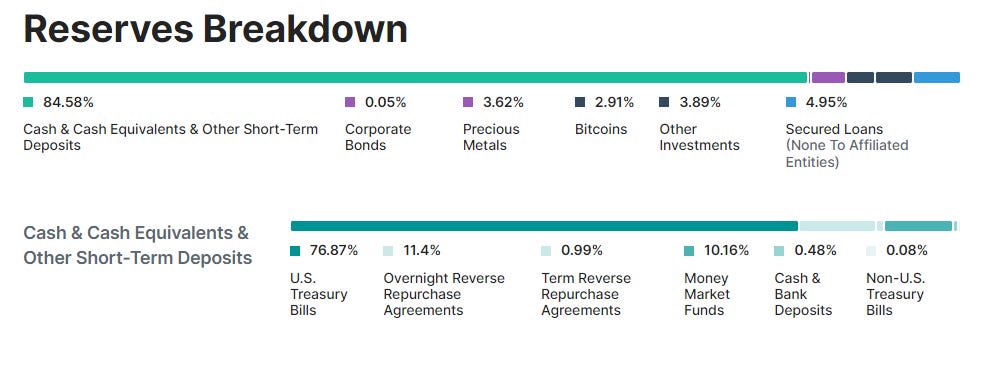
As a result, we can tell that a total of 10.42% of USDT reserves are comprised of non-financial assets. In total, 10.42% of USDT reserves comprise non-financial assets. However, precious metals and bitcoin, at least, are assets that are readily convertible to cash. The remainder of the assets, held in cash, cash equivalents, bonds, stocks, and secured loans, are typically viewed as financial instruments.
As a result, I assessed whether USDT is still appropriate to account as a financial asset in the same manner as USDC based on the following:
90% of USDT reserves are financial assets;
At least 6% of the remaining 10% of non-financial and potentially non-financial assets are readily convertible to cash assets;
Moreover, in practice, Tether has not exercised the right to settle USDT with the non-financial assets it holds in reserves.
Therefore, I believe that USDT should be accounted for as a financial asset.
It is not clear which items are included in the 'other investments' category; thus, we conservatively categorize this line item as potentially non-financial assets.