

Our Partners
CPE Flow
Annual membership at CPE Flow is designed to provide you with an all-access pass to the entire library of cutting-edge CPE courses and resources tailored to your continuing professional education needs.
CPE Flow Annual Membership Plan
Consolidating Financial Data of Newly Acquired Companies in the Group’s Financial Reporting Process
Today we will work through one consolidation accounting example where we will learn step-by-step how changes in every single input or assumption affect the consolidation journal entries and show how to present each layer of these changes in a consolidation worksheet.
In our example, we will use positive amounts to display debit balances and negative amounts (using parentheses) to display credit balances. We will assume that there are two companies – Company P (Parent) and Company S (Subsidiary). Both entities have a reporting period ending on December 31, 20X2. Company P obtains control of Company S in a business combination. Company P follows US GAAP accounting principles. However, for illustrative purposes only, we show intermediate steps that, by themselves, may not be consistent with US GAAP; to comply with the standards, these steps must be combined with the immediately following steps. All amounts below are stated in thousands of US dollars unless stated otherwise.
Prior to the acquisition, the following items are included on the balance sheets of P:
Property, Plant and Equipment (PP&E) of $30k,
Cash and Cash Equivalents of $120k,
Accounts Payable of $(25)k,
Share Capital of $(25)k, and
Retained Earnings of $(100)k
On the balance sheets of S:
Property, Plant and Equipment (PP&E) of $30k,
Cash and Cash Equivalents of $15k,
Accounts Payable of $(5)k,
Share Capital of $(15)k, and
Retained Earnings of $25k.

Step 1. Consolidation at the acquisition date on the first day of the year
Step 1 of our example begins with the acquisition of a subsidiary on 1 January 20X2. Each subsequent step modifies one item from the previous step and shows its effect on the consolidation worksheet. Unless otherwise stated, the preceding assumptions continue to apply.
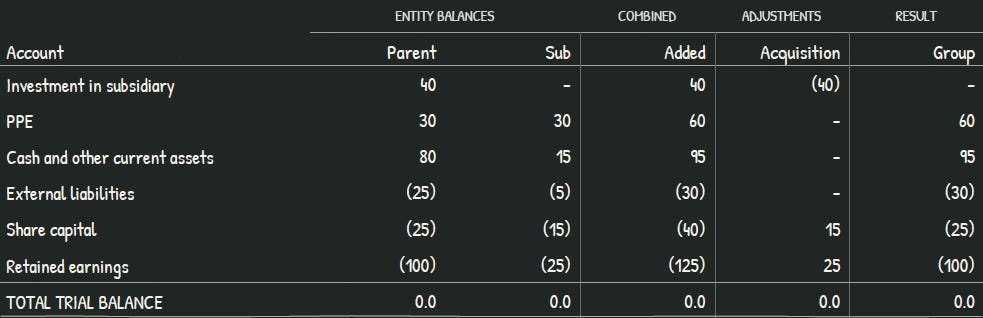
At the acquisition date, S has net assets of $40k calculated as total assets reduced by liabilities or, alternatively, as the sum of equity accounts. In Step 1, we assume the book value of net assets approximates their fair value and that the total consideration paid equals the fair value of its net assets.
In the consolidation worksheet, P’s investment is eliminated against S’s equity accounts as of the acquisition date. As a result, the subsidiary’s assets and liabilities are added to the Group’s assets and liabilities, presenting the assets and liabilities of the consolidated group rather than the assets and liabilities of any standalone entity.
Step 2. Consolidation at the acquisition date at the end of the first quarterly period
Now let’s assume that P acquired S three months later, on April 1.
During the first quarter, S generates revenue of $30k and incurs expenses of $26k. The resulting $4k profit fully converted to cash, increasing Cash and Cash Equivalents from $15k to $19k and Net Assets from $40k to $44k. Assume the consideration paid still equals the fair value of net assets, now $44k. All other assumptions remain the same.
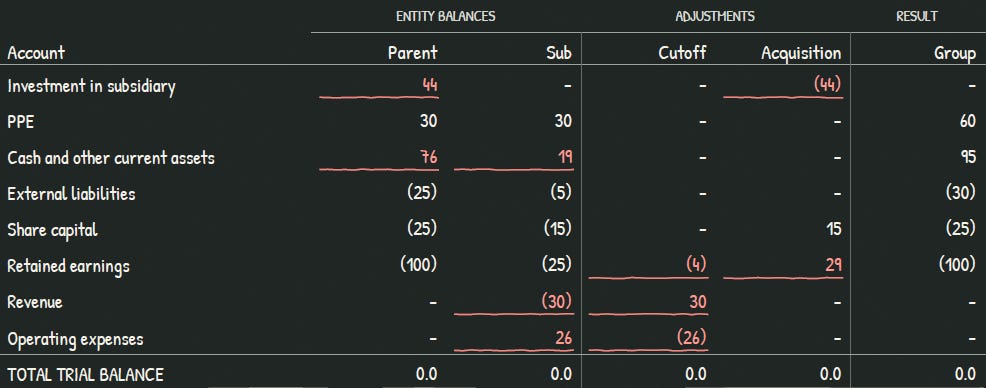
To consolidate, we now need to perform a “Cut-off” procedure (also sometimes referred to as the reformation of income statement accounts). S’s trial balance sheet presents year-to-date (YTD) earnings as P&L account balances. Those accounts represent results of operations prior to the date of acquisition; however, the consolidated P&L should only include results of operations of S since the date of acquisition. Therefore, we excluded YTD earnings by including the Cut-off adjustment and transferred the $4k pre-acquisition profit to S’s acquisition-date retained earnings, which now have a balance of $(25)k+$(4)k=$(29)k.
We then add the “Acquisition” adjustment to eliminate P’s $44k investment against S’s net assets of $44k, consisting of share capital of $15k and acquisition-date retained earnings of $29k.
Step 3. Consolidation at the fiscal year-end
Next, we will prepare the consolidation worksheet for the same group and acquisition date, but 9 months (3 quarters) later, at fiscal year-end. Between April 1 and December 31, S generated revenues of $(110)k and incurred expenses of $99k, producing a net result of $(11)k periodic income.
December 31 historical trial balance of S exported from the local ERP includes a twelve-month revenue figure of $(140)k, consisting of $(30)k earned during the first quarter and $(110)k earned in subsequent (second through fourth) quarters of the year. It also shows twelve-month expenses of $26k (first quarter) + $99k (second through fourth quarters) = $125k. We assume income earned fully converts into cash, increasing Cash and Cash Equivalents up to $30k. S’s annual income accounts have not yet been closed and show the full annual amount of earned revenues and incurred expenses prior to and after the acquisition date. For simplicity, we will continue to assume that P has no income or expenses during this year.
S’s annual earnings of $(15)k are therefore divided between the $(4)k earned before the acquisition date and the $11k earned afterward. Only the latter contributes to consolidated profit.
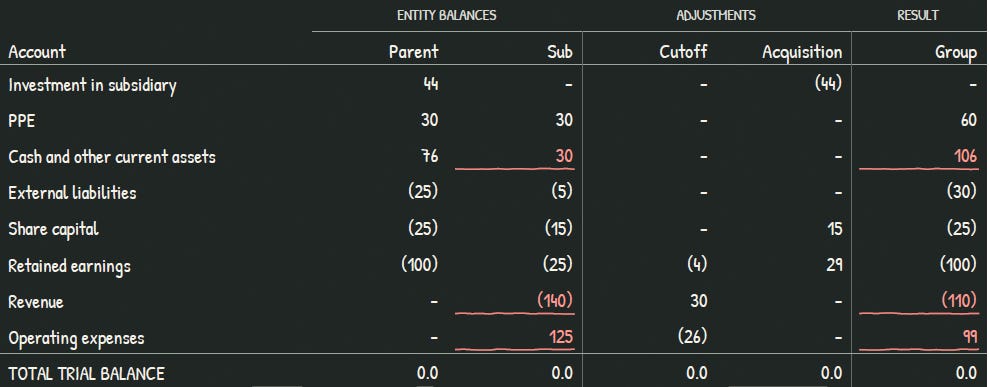
First, we repeat our Cutoff adjustment to remove pre-acquisition income earned during the first quarter. Consequently, the group’s revenue for the year equals S’s revenue earned after the acquisition date of $110k. The same applies to incurred expenses of $99k. This results in the group’s consolidated income being $11k at the end of the fiscal year.
After year-end, we will close consolidated income to the Retained Earnings account attributable to the respective company, increasing the account balance from $(100)k to $(111)k.
Step 4. Consolidation when the purchase price exceeds the fair value of net assets
Now let’s assume that P paid $90k to acquire S on April 1. The higher purchase price requires an additional $46k cash payment, reducing P’s remaining cash from $76k to $30k.
At the acquisition date, the fair value of S’s identifiable net assets remains $44k. Because the consideration paid exceeds that amount, the difference of $90k − $44k = $46k is recognized as goodwill.
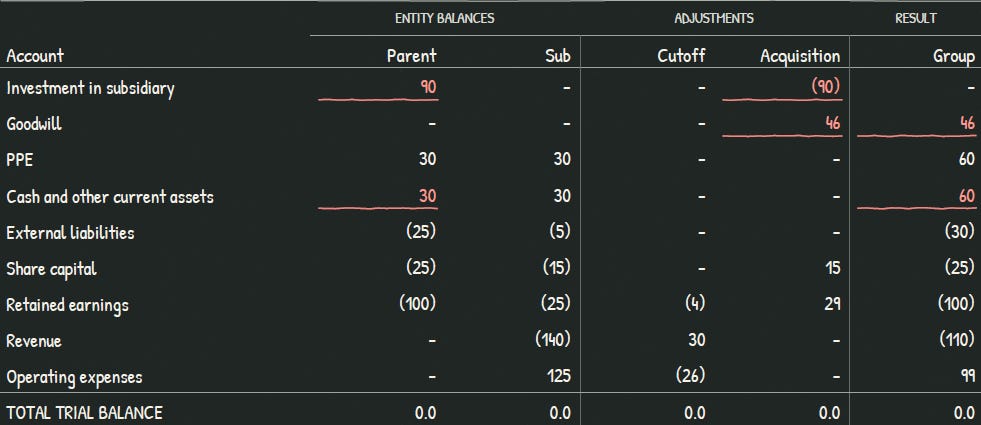
In the consolidation worksheet, the “Acquisition” adjustment eliminates P’s $90k investment against S’s acquisition-date equity of $44k and recognizes goodwill of $46k. The cutoff adjustment continues to transfer the $4k first-quarter profit to acquisition-date retained earnings, as in the preceding step.
The higher payment reduced consolidated Cash and Cash Equivalents by $46k, which formed the goodwill account balance, also $46k.
Step 5. Consolidation when the fair value of land exceeds its book value
Next, let’s assume at the acquisition, the fair value of land held by S was determined to exceed its book value by $25k. The consideration paid remains $90k.
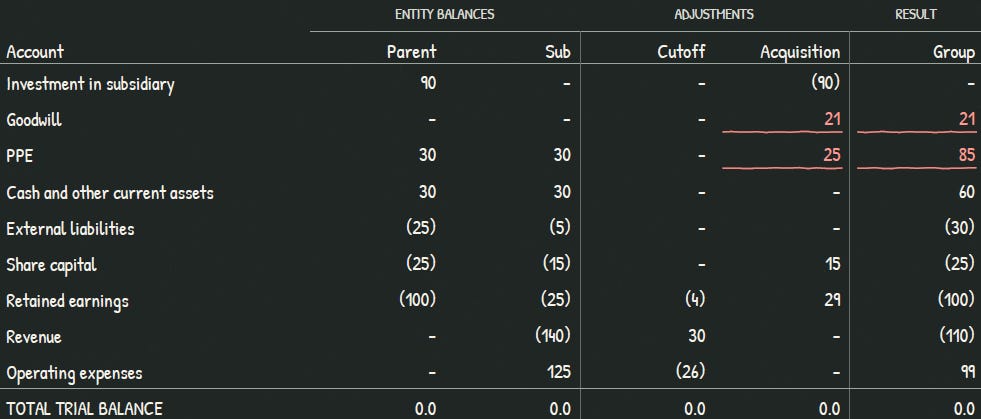
The land adjustment increases the fair value of identifiable net assets from $44k to $69k. Consequently, a larger portion of the purchase price is attributable to identifiable assets, reducing goodwill to $90k − $69k = $21k.
In the consolidation worksheet, the Acquisition adjustment now includes a $25k increase in Property, Plant and Equipment (PPE). Compared with Step 4, goodwill decreases by the same amount, from $46k to $21k.

Total consolidated assets remain unchanged because the adjustment reallocates $25k from goodwill to land. No adjustment to subsequent earnings is needed because land is not subject to depreciation.
Step 6. Consolidation when P acquires an 80 percent controlling interest
Now let’s assume that P acquires 80% of S for $90k, with the remaining 20% held by outside shareholders. We have retained the consideration from Step 5 while changing the ownership percentage acquired. The outside shareholders’ interest is presented in consolidated equity as a noncontrolling interest (NCI).
For this intermediate step, we will record NCI in a manner similar to the IFRS 3 option to measure qualifying present ownership interests at their proportionate share of identifiable net assets. Step 7 then illustrates fair-value measurement, which is required under US GAAP for the assumed business combination.
The fair value of S’s acquisition-date identifiable net assets remains $69k, including the $25k land uplift. Acquisition-date NCI is therefore 20% × $69k = $13.8k. Goodwill equals the consideration paid plus NCI, less identifiable net assets:
$90k + $13.8k − $69k = $34.8k.
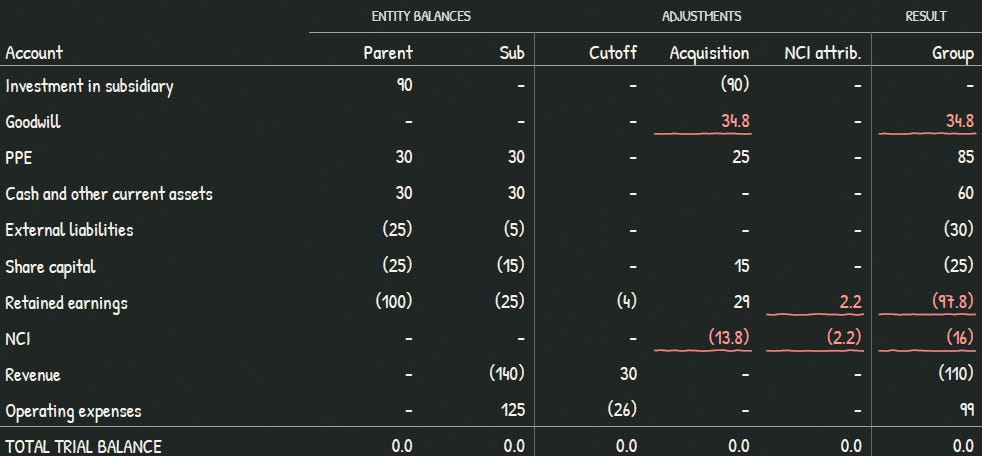
Because P controls S, the consolidated financial statements include all of S’s assets, liabilities, revenue, and expenses. The ownership percentages determine how the post-acquisition profit is attributed between P and the outside shareholders.
Of the $11k earned after acquisition, 80%, or $8.8k, is attributable to P, and 20%, or $2.2k, is attributable to NCI. Adding the latter amount to acquisition-date NCI gives a closing balance of $13.8k + $2.2k = $16k.
The worksheet reflects the $2.2k profit allocation by debiting retained earnings and crediting NCI. At this stage, the income accounts remain open, so retained earnings attributable to P appear as a credit balance of $(97.8)k, calculated as $(100)k + $2.2k.
Closing the full $11k consolidated income then increases that credit balance to $(108.8)k. This equals P’s opening retained earnings of $100k plus its $8.8k share of S’s post-acquisition income.
Step 7. NCI recognized at fair value
For the next step, P still acquires an 80% controlling interest for $90k, but acquisition-date NCI is now measured at its fair value of $20k.
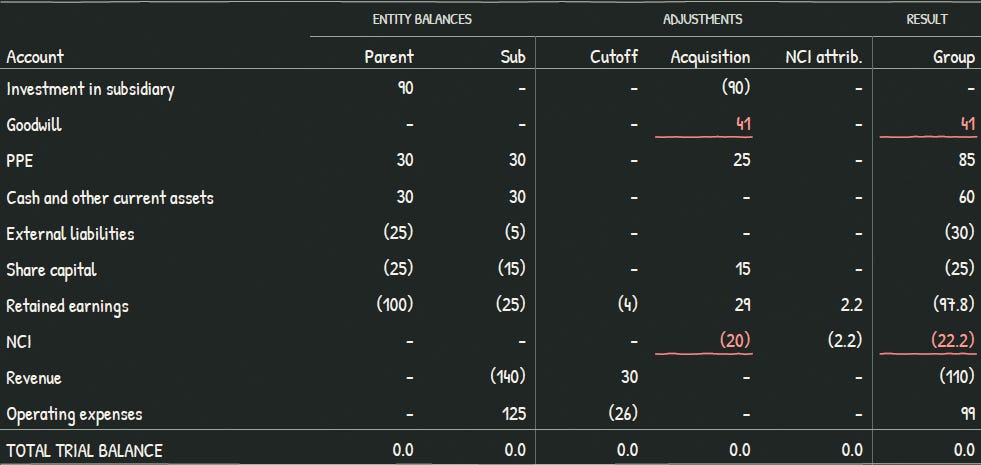
With identifiable net assets remaining at $69k, goodwill calculates as:
$90k consideration + $20k NCI − $69k identifiable net assets = $41k.

Compared with Step 6, acquisition-date NCI increases by $6.2k, from $13.8k to $20k. Goodwill increases by the same amount, from $34.8k to $41k.
The ownership percentages and post-acquisition operating results remain unchanged. NCI is still allocated $2.2k of the $11k profit, bringing its closing balance to $20k + $2.2k = $22.2k. Retained earnings attributable to P close at $108.8k, including its $8.8k share of the profit.
Step 8. Intercompany balances
Next, assume that after the acquisition, S paid $5k in accounts payable for a consulting engagement ordered by P, and P financed this payment by extending a $5k advance to S. S uses the proceeds to repay its existing $5k accounts payable.
On P’s books, the transfer reduces cash from $30k to $25k and creates a $5k intercompany receivable from S. On S’s books, these activities leave cash at $30k and an intercompany payable of $5k to P.
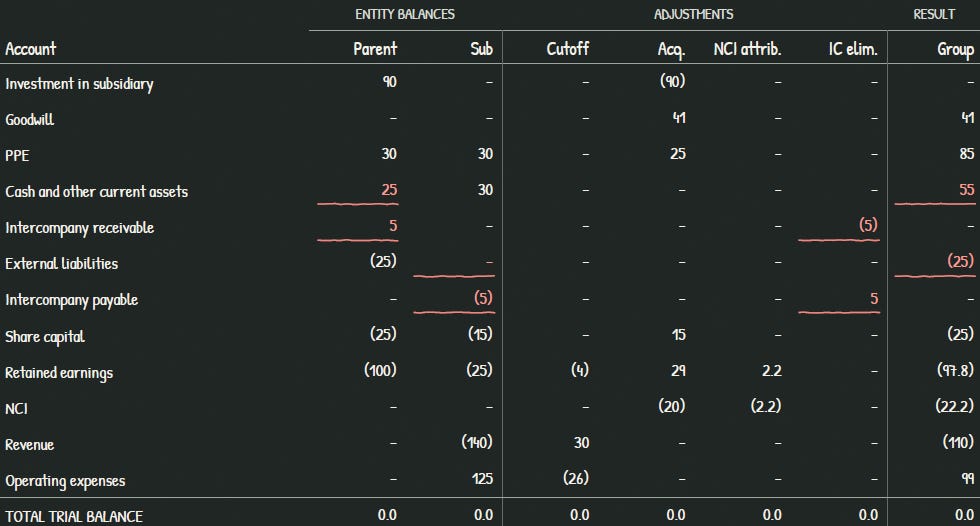
The receivable and payable represent amounts owed between entities within the same group. Therefore, we eliminate them with a $5k debit to the intercompany payable and a $5k credit to the intercompany receivable.
This elimination reduces the combined entities’ assets and liabilities by $5k each. Separately, the repayment to the external lender has reduced the group’s cash and accounts payable by $5k.
Step 9. S elects pushdown accounting
Up to this point, consolidation adjustments have been used to recognize the acquisition-date land uplift and goodwill. Now let’s assume that S elects pushdown accounting on April 1, adopting the acquisition basis in its separate financial statements. We continue with the $41k goodwill balance and the $25k land uplift from Step 7.
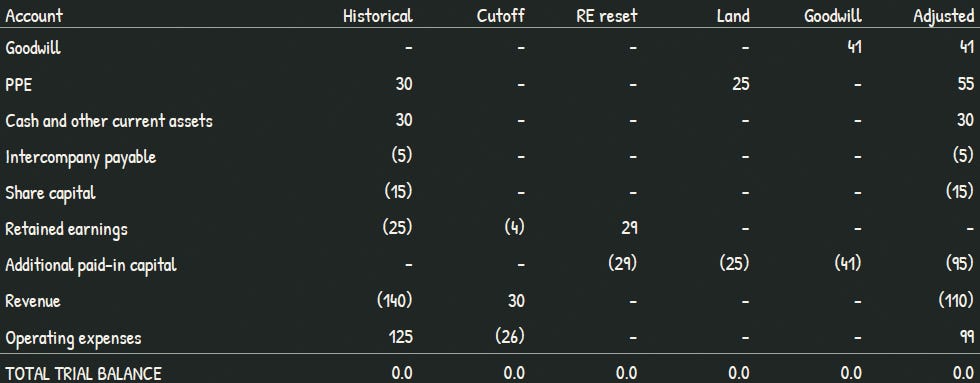
The worksheet first shows the reconciliation of S’s historical trial balance as of the acquisition date. As in the earlier cutoff adjustment, the $4k first-quarter income is removed from P&L accounts and included in retained earnings at acquisition. This increases the Retained Earnings account from $(25)k to $(29)k. It should be noted that the cut-off adjustment would not be recorded in the separate books of S.
The pushdown adjustments then reset the $29k acquisition-date retained earnings balance and recognize the $25k land uplift and $41k goodwill. Our policy is to balance adjustments to net assets with the additional paid-in capital (APIC) account, which captures the total $(95)k offset to the increase in net assets value, while maintaining the existing share capital balance of $(15)k. Together, share capital and APIC represent acquisition-date equity of $110k, equal to P’s $90k consideration plus the $20k acquisition-date fair value of NCI.
After the subsequent operations described above, S’s adjusted trial balance contains revenue of $(110)k and expenses of $99k related to April through December.
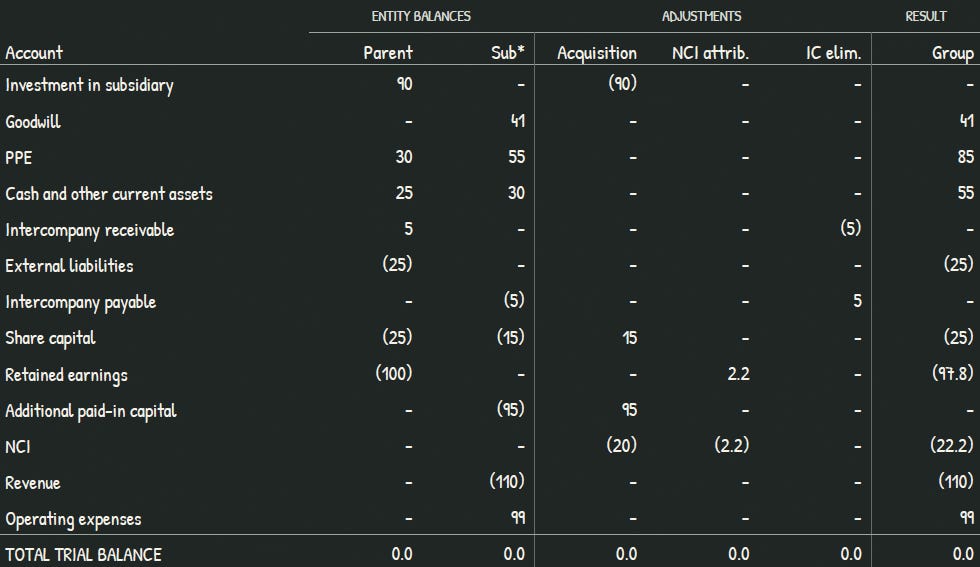
The consolidation worksheet now starts with these pushdown-adjusted balances. The “Acquisition” adjustment eliminates S’s $15k share capital and $95k APIC against P’s $90k investment and recognizes acquisition-date NCI of $20k. Goodwill and the land uplift enter the consolidated figures through S’s recorded balances.
The intercompany elimination and allocation of post-acquisition profit remains the same as in the previous step: consolidated income of $11k, comprising $8.8k attributable to P and $2.2k attributable to NCI.
The worksheet shows retained earnings attributable to P of $(97.8)k, which already reflects the $2.2k adjustment for the portion allocated to Non-Controlling Interest. Closing consolidated P&L accounts will bring retained earnings to $(108.8)k, while closing NCI is $22.2k.
Conclusion
Today we reviewed a simple illustration of consolidation accounting setup for a newly acquired subsidiary. This was a theoretical exercise intended to demonstrate how accounting teams can use trial balance sheet reports and consolidation analysis to incrementally transform combined account balances into consolidated account balances. In our future issues, we are going to delve into some practical organizational aspects associated with acquisitions of new subsidiaries, and pay particular attention to aspects specific to the Web3 industry.
Rare Gems
The Book of Jargon. US Corporate & Bank Finance. Glossary of US Corporate and Bank Finance Slang and Terminology by Latham & Watkins [here]
Combining Portfolio Companies: Demystifying the Accounting Implications by BDO [here]
Post-Acquisition Integration Handbook by Baker McKenzie [here]
Strategic Accounting with Andrei
Want to learn about integrating business strategy into your accounting process? Curious about the latest guidance? Or maybe you just want to get quick wins?
Our newsletter offers real insights from practitioners. If you have a topic you’d like to discuss, book some time with me!
Improve Your Accounting Strategy
Is your accounting strategy underutilized or non-existent? Schedule a complimentary call with me to learn how you can strengthen your process.


