This article addresses US GAAP accounting for a for-profit company that establishes or contributes to an affiliated not-for-profit foundation.
1. How should reporting entities account for the creation of an affiliated not-for-profit foundation and related initial contributions made?
The Company should first assess whether the Foundation should be consolidated under ASC 810. Qualifying not-for-profit entities generally fall within the exception to the variable interest entity model in ASC 810-10-15-17(a). The Company therefore evaluates consolidation under the general consolidation guidance. The exception does not apply when the Foundation is used to circumvent the variable interest entity requirements.
A conclusion not to consolidate is generally supportable where the Company has no direct financial interest in a charitable Foundation and cannot obtain economic benefits from its resources. Management should document this assessment based on the Foundation’s governing documents and its arrangements with the Company. Affiliation or the ability to appoint directors does not, by itself, resolve the assessment.
Assuming the Foundation is not consolidated, initial funding is accounted for under the contribution guidance discussed below. Establishing the Foundation does not, by itself, create an investment asset for the Company. Formation expenditures that qualify as organization costs under ASC 720-15 are expensed as incurred.

2. How should reporting entities account for contributions made to affiliated not-for-profit foundations?
Assuming the Foundation is not consolidated, charitable contributions are accounted for under ASC 720-25, Other Expenses: Contributions Made. This guidance incorporates relevant provisions of ASC 958-605 for assessing whether a contribution is conditional:
Under ASC 720-25-25-1, an unconditional contribution is recognized as an expense when made. An unconditional promise to give cash is recognized as contribution expense and a corresponding liability when the promise is made. Payment subsequently settles that liability.
A conditional contribution generally requires both a substantive barrier and a right of return of transferred assets or release from the funding obligation. Contribution expense is recognized when the applicable conditions are substantially met or explicitly waived. A restriction on how the Foundation uses the contribution is not a condition.
Management should distinguish a promise to give from an intention to give. A public announcement of an intention to contribute does not necessarily create an unconditional promise, but a written contribution agreement or a verbal agreement with third-party witnesses likely will. Management should then still assess whether the agreement contains donor-imposed conditions and how these conditions affect the timing of expense recognition.
In retrospect, a written contribution agreement or a physical transfer of contributed assets from the Company to the Foundation could confirm the enforceability of the legal obligation on the date of such an event and, therefore, the existence of a promise to give on that same date. If an unconditional promise existed before the agreement or transfer, expense recognition is required when that promise was made. If no earlier promise existed, an immediate, unconditional transfer is recognized as contribution expense when made.
3. How should reporting entities account for equity contributions made to affiliated non-profit foundations?
The Company should distinguish donations of its own shares from donations of investments held in other entities.
When the Company issues its own common shares as an immediate, unconditional charitable contribution to an unconsolidated Foundation, it recognizes contribution expense at the fair value of the shares. The corresponding credit is recorded in common stock and additional paid-in capital.
For example, assume the Company donates 100,000 newly issued shares with a fair value of $10 per share and a par value of $0.01 per share. Assume no contribution obligation was previously recognized.
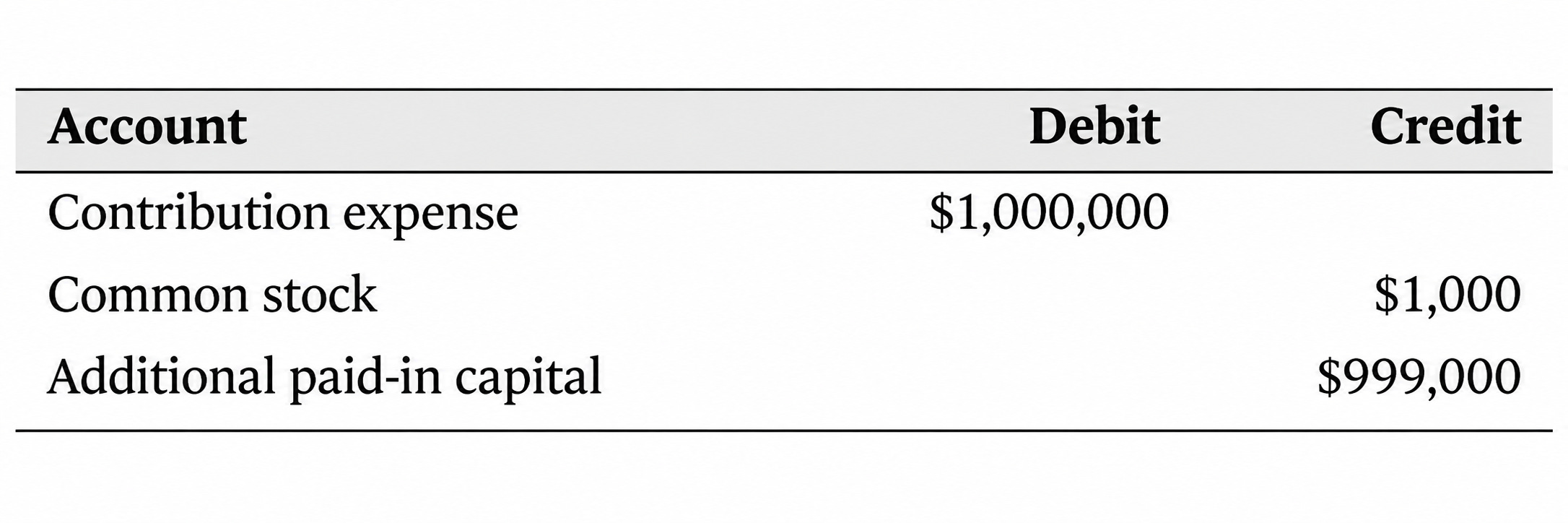
The contribution reduces pretax income without a cash outflow. Before tax effects, the increase in contributed capital offsets the reduction in retained earnings, leaving total equity unchanged.
A promise to issue shares in future periods requires a separate assessment of its terms and recognition date. Management should not automatically defer expense until issuance if an unconditional contribution obligation already exists.
If the Company contributes shares held in another entity, it transfers an investment asset. Management must apply the contribution guidance together with the derecognition requirements applicable to that investment. A transfer that results in the loss of control of a subsidiary requires analysis under ASC 810.
Improve Your Accounting Strategy
Is your accounting strategy underutilized or non-existent? Schedule a call with me to learn how you can strengthen your process.